Canoes are lightweight boats pointed at both ends and propelled by one or more paddles. They are said to be ideal for single paddlers, couples, and even small families.
But before getting one, you must know how much weight limit a Canoe has and how many people you can fit in one Canoe without exceeding the maximum power limit.
The Weight Limit For Canoe
To determine how many people you can accommodate, you must first consider the maximum capacity of your Canoe and the weight it can hold at once.
The average canoe can hold a maximum of 940 pounds of overall weight. This is a much-generalised statement and can differ with Canoe sizes, Canoe designs, and passengers weight differences.
For a proper comparison, combine your weight, the weight of any passenger who may be on board with you and the weight of safe amount of gear.
It’s best to leave 10 – 20 lbs of leeway in case you add any additional gear.
How Many People Can Fit In a Canoe
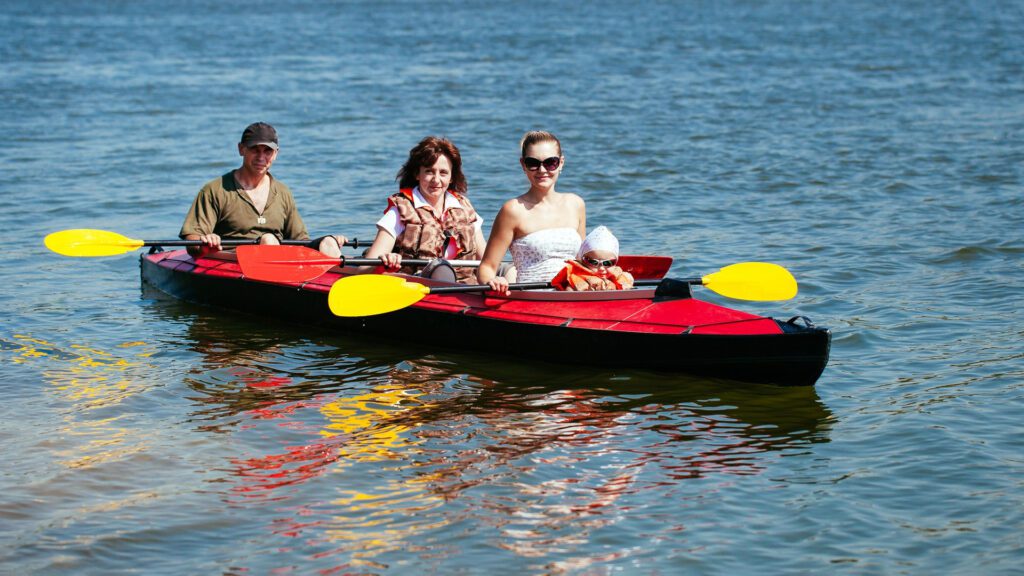
Now onto the other main factor. How many people can you fit in a Canoe? In general, you can fit between 2 and 4 people in a Canoe without any problem (according to my research).
And if I am to talk about my Canoe, it is a 17 foot Canoe that can fit at least 4 adults weighing 180 lbs or two adults and 4 small children without the chance of possible tripping.
Factors Affecting Canoe Weight Limits
Now that I have mentioned that differences might come in the capacity and weight limit. Let’s get into more detail on what exactly are the factors that affect how much weight a Canoe can hold.
| Factors | How They Affect Weight Limit |
| Material and Design | The materials and design of a Canoe (especially the hull) significantly impact its weight limits and overall carrying capacity. Different materials, such as aluminum, fiberglass, and polyethylene plastic, differ in characteristics and tolerance. The dimensions and shape also determine weight distribution and water interaction. |
| Volume and Buoyancy | This factor effects the Canoe’s ability to support weight. A higher volume and greater buoyancy allow the Canoe to hold more weight all without compromising stability. |
| Number of Paddles | The number of paddlers you Canoe has will also affect the weight distribution your Canoe will accommodate. For example, my Tandem Canoe is designed with two paddlers and has a higher weight limit so that synchronized movements are possible. |
| Gear And Equipment | As I said above, you need to consider the gear and equipment before evaluating how much weight your canoe can hold, including the combined weight of passengers and gear. This is because these necessary equipment will nonetheless take space and must be balanced with buoyancy in order to maintain stability and a smooth gliding experience. |
| Depth | A canoe’s depth (the distance between the gunnel and the hull’s bottom) also has an impact on the maximum weight capacity limits that the Canoe may hold. |
| Water Conditions | Canoe weight limitations also change based on the type of water conditions that it might encounter. With calm lakes there is much more flexibility and weight leeway in comparison to rivers and seas. This is because rivers and seas have unpredictable currents that will require full consideration for safety. |
Why Canoe Weight Limits Are Important to Consider
But hey, why are we even considering weight limits? Just allow as many people who cares.
We both know that is very superficial and impractical and if one does that they are automatically signing up for trouble. Let’s get into the depths of this.
Equilibrium is Safety
Water activities already involve a lot of risk, so why welcome another element of risk? Here are the benefits of maintain the safety principles through weight guidelines:
- No Possible Capsizing and Swamping: Canoes need equilibrium to maintain stability. If you add excessive weight, you may upset the equilibrium requirements, which can increase your chances of drowning and capsizing, specifically in adverse or harsh weather conditions.
- Enhanced Buoyancy: As I mentioned above, Canoe trips rely on buoyancy. Staying with in the weight limits ensures that the Canoe’s buoyancy stay at the optimal level. This also reduces the risk of water entering in your Canoe.
Maintaining Stability
Canoes are designed with specific weight distributions, which contribute to their stability. Going beyond the weight limits can compromise this stability. This can result in:
- Dangerous Tilting: Overloading a canoe causes it to tilt to one side, significantly diminishing its stability. Also, you would find that the waterline would get near the gunwales. This would mean that if there’s any tipping, the canoe could be swamped.
- Unpredictable Maneuvering: An overloaded canoe becomes less responsive to paddling inputs, making navigating through obstacles or currents challenging, especially when considering the weight in people and gear. Staying within the weight limit ensures that the canoe maintains its agility and maneuverability.
Consider Canoe Types
There are different types of Canoe that cater to varying maximum weight limits and functionalities. Here are the different types of Canoe’s that I have come across:
- Recreational Canoes: These boats are designed for leisure paddling on calm waters. Hence, these canoes typically have moderate weight limits and can’t accommodate a lot of people, affecting their passenger capacity.
- Touring Canoes: These canoes are designed for longer journeys, and they typically have higher canoe motor capacity. They accommodate extra gear and are designed for stability even in differing water conditions.
- Whitewater Canoes: These canoes are built to navigate fast-moving waters and rapids. Due to their specialized design, they usually have lower weight limits, too.
Different Canoe Sizes
Now, onto the sizes. Yes, along with types, there are different sizes available, too. This allows small and large quantities of paddlers to choose what suits them.
Let’s take a closer look at all the sizes available so you can determine how much weight capacity of a Canoe you will need.
One person Canoe
A one-person or solo canoe is designed to accommodate solo paddlers and any of their Canoeing gear and camping equipments. Hence, these canoes only carry one person; they’re shorter and smaller than others.
Their shorter size makes paddling and maneuvering through the water far easier.
Moreover, a single-person canoe is 13 to 15 feet long and has a center seat to distribute the paddler’s weight evenly so the buoyancy doesn’t get affected. But that doesn’t mean that it has a higher weight limit.
The average 14 foot canoe can hold 700 pounds of passengers and gear at maximum capacity.
In fact, its most prominent drawback is its low weight capacities and lack of versatility.
As solo canoes are meant for single paddlers, you’ll find that their weight capacities are far lower than tandem canoes and even lower than three or four-person canoes.
Two Person Canoe (Tandem)

If you have a partner to accompany you, you will need a two-person Canoe. These Canoes are made to accommodate two paddlers and any additional gear they might have.
Having a two-person Canoe is much more versatile, in my opinion, as they can be used for a single paddler, two paddlers, and occasionally slightly more than that, too, depending on the boat’s configuration.
Moreover, these Canoes are longer and range from around 15 feet all the way up to 17 feet and can hold up to 1160 pounds of weight in total (passengers and gears).
Three Person Canoe
After the two-person canoe, of course, we have a three-person Canoe, too. These Canoes can carry up to three people and their gear. They’re great for small families or couples with pets as they’re longer and have more seating options throughout the cockpit.
If talking about size, three-person Canoes come in at 17 to 18 feet in length. Yes, this might attract you with how many passengers it can hold, but remember, the longer it will be, the harder it will be to control.
Four Person Canoe
Four-person canoes, which can hold up to four people, are the least popular of the bunch. That’s because of their size and the specific weight capacities they can hold. They are around 20 feet long, making them heavy and difficult to transport and store.
Their additional size also makes most canoes of this length more expensive.
Even Larger Canoes
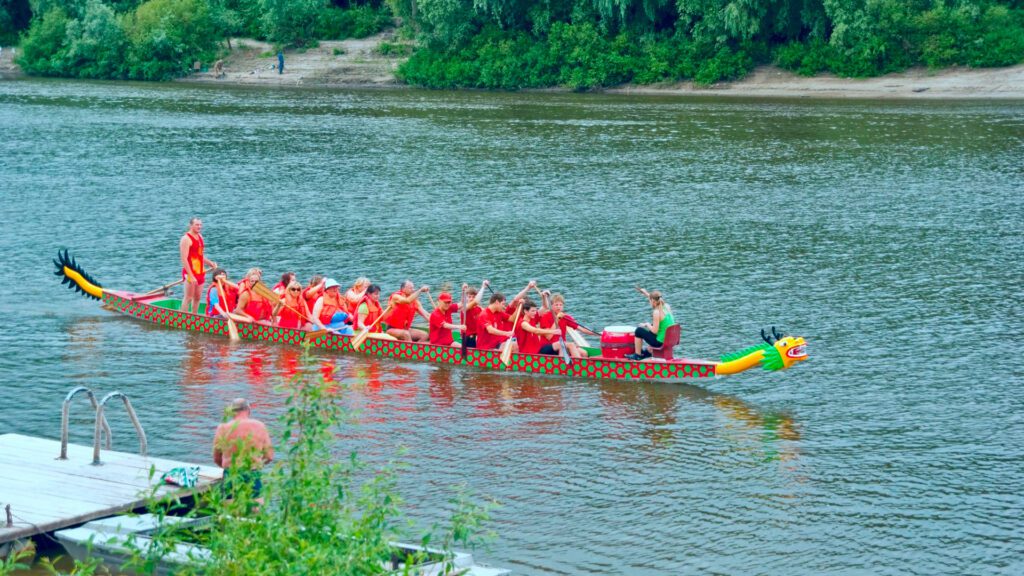
A four person Canoe isn’t the end too. You will also come across some Canoes that can hold up to 18 passengers. These Canoes are supposed to be used for guided tourist trips and adventures with a lot of people only.
So, I hope you know not to pick this one for your average family trip.
Calculating How Many People Your Canoe Can Hold
Take a tape measure and measure the total height and width of your canoe in feet. You should measure the widest part in the canoe’s center from the end of the stern to the end of the bow for height and for width.
Once you have these numbers, multiply the length and width. Then, divide your answer by the average weight of the passengers on board. Let’s say, for this instance, it’s 150, so we’ll divide by 15.
An Example:
So, if my canoe is 15 feet long and 3 feet wide, my calculations would be as follows:
15 x 3 = 45
45/15 = 3
| Additional Note: If you aren’t good at math, you can also look up your canoe online. The manufacturer’s website should have all the dimensions and specifications that can easily help you determine the overall capacity. |
Can I Use a Kayak Instead? Difference Between a Canoe and a Kayak
You might have also considered using a Kayak, as both look similar. But these boats are different and you must know you won’t get the Canoeing experience in a Kayak and vice versa.
- Purpose: Kayaks are favored for competitive conditions or challenging water. Canoes, on the other hand, are for family trips and peaceful boating on calm waters.
- Design: Canoes normally have an open deck as they are made for picnics and tourist trips. Meanwhile, Kayaks, on the other hand, tend to have a closed deck. Moreover, due to their open design, Canoes offer much more freedom. Kayaks, on the other hand, offer more secure seating and protection with their closed deck.
Which Canoe Is Best For Me?
When deciding which canoe is best for you or your family, you must keep certain factors in mind.
First, list the number of people you have with you. Then, consider the total weight of all passengers and gear and calculate as guided above. Finally, don’t forget to consider the Canoe’s length, overall storage space, and paddling efficiency.
After keeping these things in mind, you will be able to better evaluate which Canoe you should go for and how many people it will fit.